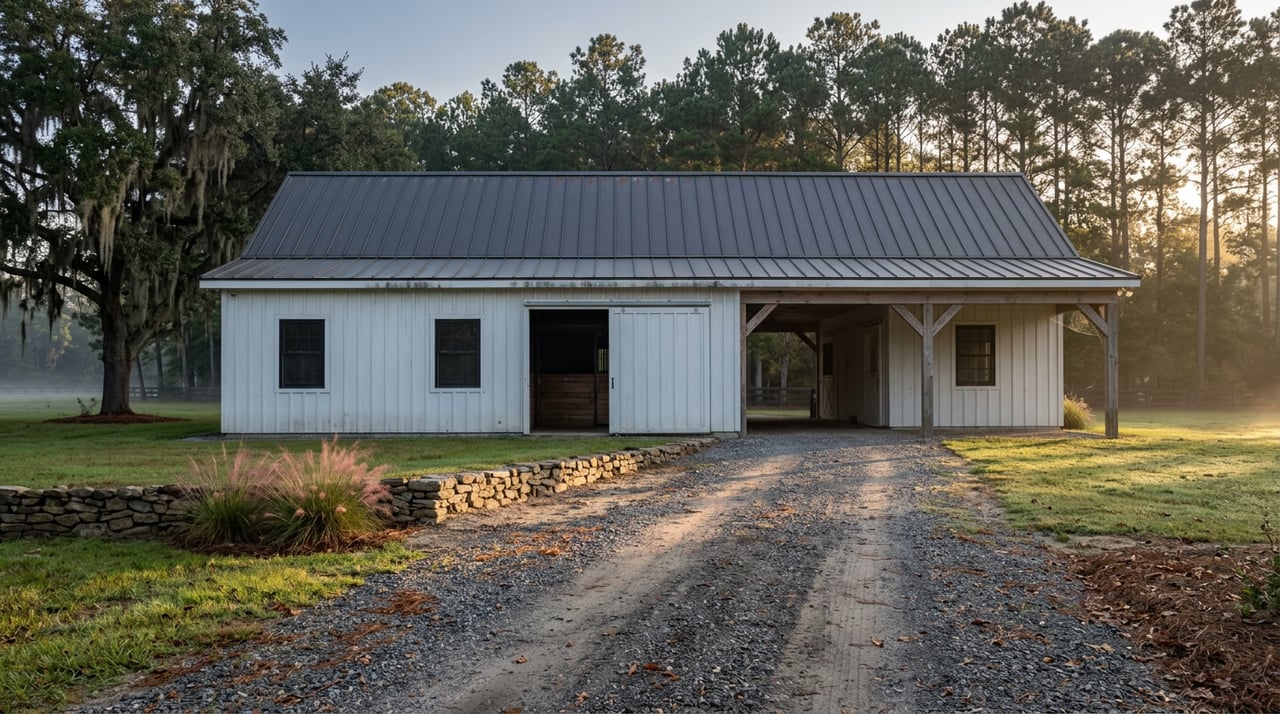
The Tax Bill on That Reddick Horse Farm Isn't Yours Yet
September 10, 2026
September 10, 2026
A buyer looking at a Reddick farm often does the same math: they pull the current owner's property tax bill, see a number that looks almost too good to be true for 20 or 40 acres of fenced pasture, and assume that number travels with the deed. It doesn't. The property tax bill you see on a listing reflects the seller's agricultural classification. The Brevard County Property Appraiser says the classification does not automatically follow you when the deed changes hands. You inherit the barns, the paddocks, and the fencing. You do not inherit the tax break.
This matters more in Reddick than almost anywhere else in Marion County, because Reddick sits inside what the county designates its Farmland Preservation Area, a stretch of A-1 zoned land minutes from HITS and the World Equestrian Center where the gap between a farm's market value and its agricultural assessed value can run into tens of thousands of dollars a year. Getting the classification wrong, or getting it late, is not a paperwork inconvenience. It's a line item.
Florida's Greenbelt Law, codified at Florida Statute 193.461, lets county property appraisers assess qualifying farmland at its current use value rather than its market value. For horse property, that use value is set around $500 per acre statewide, according to PropTaxAdjust's breakdown of the statute, compared to market assessments that can run into the tens of thousands per acre near WEC. The Florida Bar Journal discusses horse breeding, training, and boarding as bona fide agricultural purposes under the law. There's no statutory minimum acreage, as UF/IFAS explains.
What trips people up is the assumption that this classification is a property right, something that stays with the land like a recorded easement. It isn't. It's a status granted to a specific owner based on that owner's documented use, and multiple Florida county property appraiser offices are explicit that any change in ownership requires a brand new application. The classification doesn't carry over. You have to earn it again, on your own paperwork, under your own name.
The mechanics are simple once you see them written out, and confusing if you don't. Two dates matter every year:
For a buyer closing on a Reddick farm anytime this year, the sequence looks like this:
Close on the farm in 2026, keep horses actively boarding or training on the property by January 1, 2027, then file Form DR-482 with the Marion County Property Appraiser's office no later than March 1, 2027, to have the classification recognized for the 2027 tax year.
Miss that March 1 window and you're not just delayed. The Marion County Property Appraiser's own guidance confirms the same January 1 assessment date and notes that field appraisers will inspect the property to verify use before granting the classification, so a buyer who assumes the horses in the pasture are proof enough is skipping a step the county will not skip.
A lapse can matter if nobody notices, or if a buyer quietly stops the agricultural operation without realizing what they're giving up.
This is where sellers should pay attention too. If you've held Greenbelt status on a Reddick farm for years and you're selling to a buyer who plans to subdivide or convert the acreage to a non-agricultural residential estate, it's worth disclosing what the current classification depends on so nobody is surprised at the closing table or in the first tax notice after.
Not every Florida county treats horse boarding the same way, and this is where Reddick's location inside Marion County becomes a genuine advantage rather than just a zoning designation. A Florida Bar Journal analysis of the Greenbelt Law's application to equestrian property notes that Marion County has historically been unusually receptive to classifying boarding and training operations as agricultural on their own, while a neighboring county like Lake has required additional agricultural activity beyond boarding alone before granting the same classification. The same article points to Robbins v. Racetrack Training Center, a 2003 Third District Court of Appeal decision, which found that a property used specifically for boarding and training horses met the bona fide agricultural use standard under Florida law, without requiring any additional farm product or livestock sale.
For a buyer comparing a Reddick farm to something similar an hour away in a less horse-friendly county, that difference in how boarding alone gets treated is not academic. It's the difference between a straightforward DR-482 filing and a longer argument with a property appraiser's office that wants to see more than horses in a paddock.
The stakes here are real, not just theoretical. The ownership group behind the World Equestrian Center has kept buying land around its Ocala campus, most recently a $7.5 million purchase of a horse farm just west of its existing holdings, recorded in Marion County in December 2025. That followed the group's earlier acquisition of the roughly 900-acre Ocala Jockey Club for $10.5 million, a property now operating as the World Equestrian Jockey Club and still hosting the same eventing tradition that put it on the map. The difference between what a Reddick farm is worth on paper and what it's assessed at under Greenbelt is what makes getting the classification, and keeping it, worth the extra attention at closing.
Does the classification transfer if I keep the same horses the seller had? No. The classification is tied to the owner of record, not the animals. You'll need to file your own DR-482 application even if nothing about the farm's daily operation changes.
What if I want to convert a barn into a guest house or event space? It's worth confirming with the property appraiser's office before you start construction, not after.
Does Reddick's A-1 zoning guarantee the tax classification? Check the parcel's tax classification with the property appraiser before relying on the current tax bill.
Buying or selling a working farm in Reddick means dealing with more than fencing and footing. It means understanding which parts of the deal reset at closing and which parts you have to actively claim for yourself. If you're weighing a purchase in Marion County's horse country and want someone who has walked this ground for over two decades to help you see what a listing's tax line actually promises, and what it doesn't, Dean Graham is a good place to start that conversation. Let's Connect.
This article is general information, not legal, tax or financial advice. Consult a qualified professional about your situation.
Stay up to date on the latest real estate trends.

With over 20 years in Northcentral Florida and a diverse background spanning agriculture, equestrian sports, construction, horticulture, and real estate, Dean brings a wealth of hands-on experience and local knowledge to every client. He’s committed to providing personalized guidance and making every real estate experience clear, confident, and rewarding.